
.png?width=1920&height=1080&name=CRARS%2026%20Article%20Why%20are%20your%20climate%20risk%20assessments%20%26%20asset%20decisions%20flawed%20(7).png)
The numbers are hard to argue with. Women make up 48 per cent of Australia's workforce, yet account for only 13 per cent of working engineers. Despite over 18 per cent of engineering graduates in Australia being female, only 8 per cent enter the engineering workforce after graduation. And for those who do, the attrition rate does not stop there. Female representation in the profession drops sharply through the middle years, declining by around one percentage point annually, at a time when the industry can least afford to lose experienced talent.
These are not pipeline problems. They are culture problems. And culture, by definition, cannot be changed by the people it is excluding, at least not alone.
That is where allyship comes in. Not allyship as a value statement buried in an annual report, but allyship as a daily practice, visible, deliberate, and uncomfortable enough to mean something.
Positional power is the point
One of the most important things an ally can do is understand the currency they already hold, and spend it deliberately. When men understand the experiences of women in engineering workplaces, they can challenge their own assumptions and realise they have a part to play in removing the invisible obstacles women face. When men turn their attention to becoming good allies, the culture changes and the organisation's performance improves.
This is not about swooping in as a rescuer. It is about using positional power to change who gets the work, who gets the visibility, and who gets the opportunity to grow into leadership. It means amplifying voices that are being talked over, and calling out the pattern, not just once, in private, but consistently and in public, where it lands.
The conversation that needs to happen, and who needs to be in it
One of the most persistent frustrations in gender equity work is the composition of the rooms where it is discussed. The people who attend panels on inclusion are rarely the people who most need to change. The people with the positional power to restructure who gets promoted, who gets sponsored, and what behaviours get tolerated are often absent.
Research across three studies involving more than 1,000 participants demonstrates that an equality-supportive male ally reduces anticipated isolation and workplace hostility, and increases anticipated support, respect, and gender equality norms for women, including women in science, technology, and mathematics. The presence of a genuine ally signals to women that the environment is safe enough to stay in, and to grow.
From principle to practice
The organisations that will close the gap are not the ones with the best diversity statements. They are the ones where leaders, particularly male leaders, are held accountable for equity outcomes in the same way they are held accountable for project delivery and commercial performance.Meaningful allyship is not a personality trait. It is a practice. It can be learned, measured, and embedded into how teams operate. The question is no longer whether the case for change is strong enough. The data settled that long ago. The question is whether the people with the power to act are willing to use it.
Join us at the Women in Engineering Summit 2026
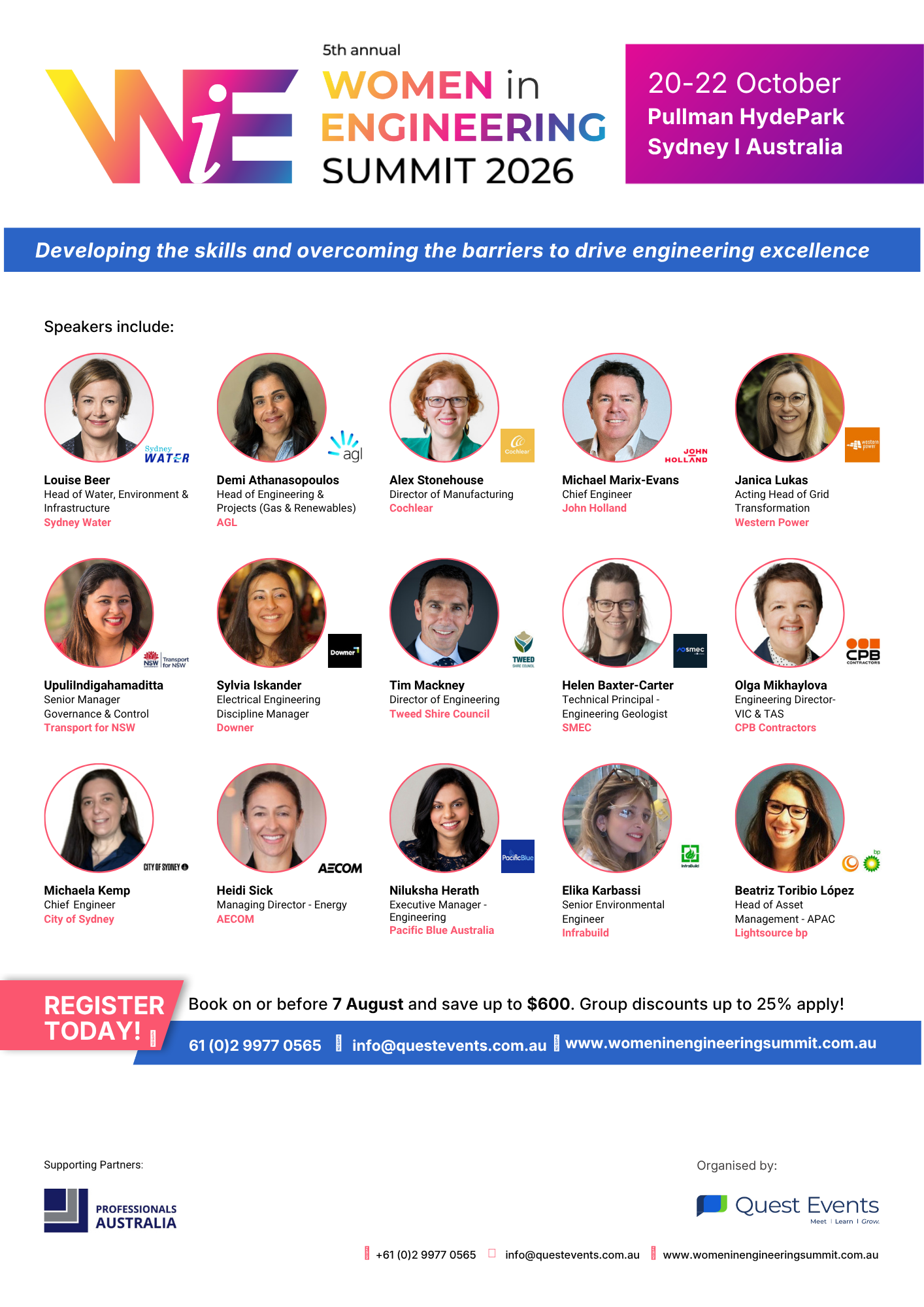
Leaders from AECOM, WSP, BG&E, Transgrid, John Holland, Stantec, Western Sydney University, University of Technology Sydney, Boeing Defence Australia, and Sydney Water will be discussing this important topic at the Women in Engineering Summit 2026 this October.
Download the Brochure